Chuckwill
For almost two hundred years, no official delegation of the Muscogee Nation had stood in the Okefenokee. In twenty twenty-two, two men from Oklahoma finally did.
To see why that mattered, go back to the Creeks. In the seventeen seventies, the naturalist William Bartram wrote down what the Creeks told him about the heart of this swamp. They said one island out there was a most blissful spot of the earth. The Muscogee name for the whole place is remembered as meaning shaking water in a low place.
Then came war. The Creek Nation lost to General Andrew Jackson, and in eighteen fourteen, at the Treaty of Fort Jackson, it gave up land that includes what is now the refuge. More treaties followed. Between eighteen thirty-two and eighteen thirty-seven, the United States removed the Creeks by force. Their descendants make their home in Oklahoma today, as the Muscogee Nation.
In twenty twenty, the Nation wrote to the Fish and Wildlife Service. It asked that the entire refuge be named a Traditional Cultural Property, a place that matters to a people for its history and its ways. The Nation sees the swamp as a sacred landscape that holds the remains of its ancestors. The Service agreed, and promised its full support.
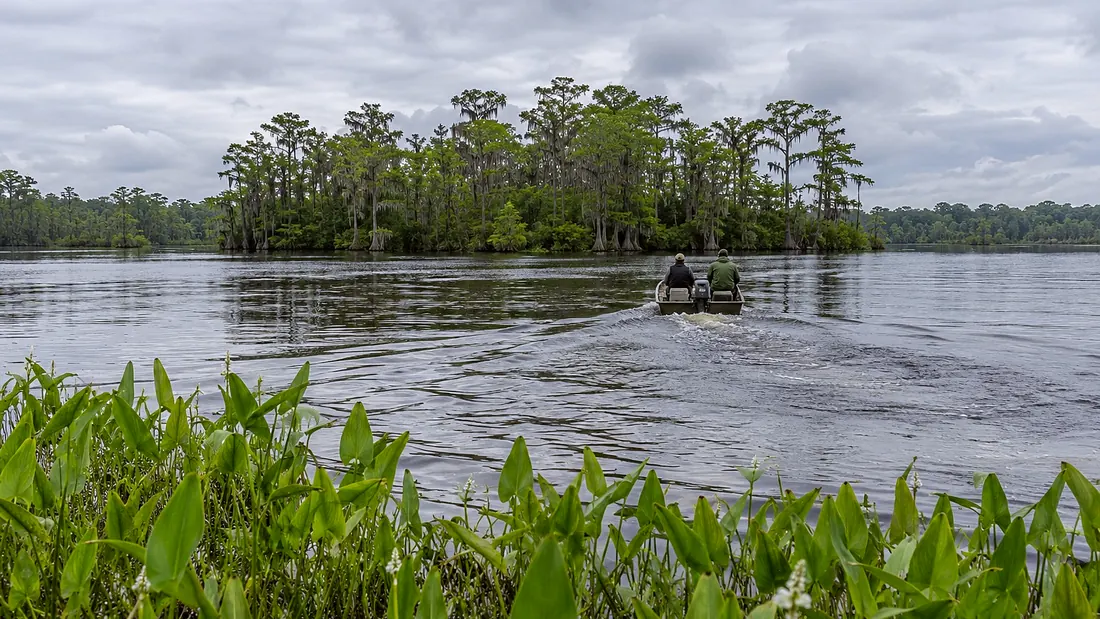
Then the visit. Turner Hunt, the Nation's historic preservation officer, and Emman Spain, who is responsible for the return and care of the Nation's ancestors and for preserving their artifacts, traveled to the refuge. Refuge staff met them. A reporter from public radio rode along on the boat.
Their first stop was Floyds Island. The two men pointed out plants the Nation still uses for food and other needs, arrowroot among them. They visited the old Hebard cabin. And they were shown what the island holds underground. There are six archaeological sites on Floyds Island, and one of them is a low burial mound. The logging railroad built by the Hebard Cypress Company had cut that mound in half.
They talked about the plan to nominate the swamp for World Heritage, which the Nation strongly supports. Back at the visitor center, staff asked them what a new visitor center ought to say. The plan was to put the tribe's history, and its long ties to the swamp, into the exhibits. And the staff told them to come back any time, and not to wait another two hundred years.
That September, the Secretary of the Interior, Deb Haaland, came to the refuge and held a round-table on its future. Principal Chief David Hill of the Muscogee Nation sat at the table. The nomination says it was the first time a Principal Chief had visited the Nation's ancestral lands and met a leading American official there since the removal. Assistant Secretary Shannon Estenoz and Georgia Senator Jon Ossoff were in the room too.
In twenty twenty-three, the refuge formed an advisory committee for its World Heritage bid. Tracie Revis, who directs advocacy for the Nation's Ocmulgee National Park and Preserve Initiative, was named to it. She proposed a cultural exchange between the Nation's people and the local partners.
The Nation has not yet sent a final proposal for the Traditional Cultural Property. The work goes on. But the name is still the name the Creeks gave this place, shaking water in a low place. For the first time in nearly two centuries, the people who gave it were back on the water to hear it.