Chuckwill
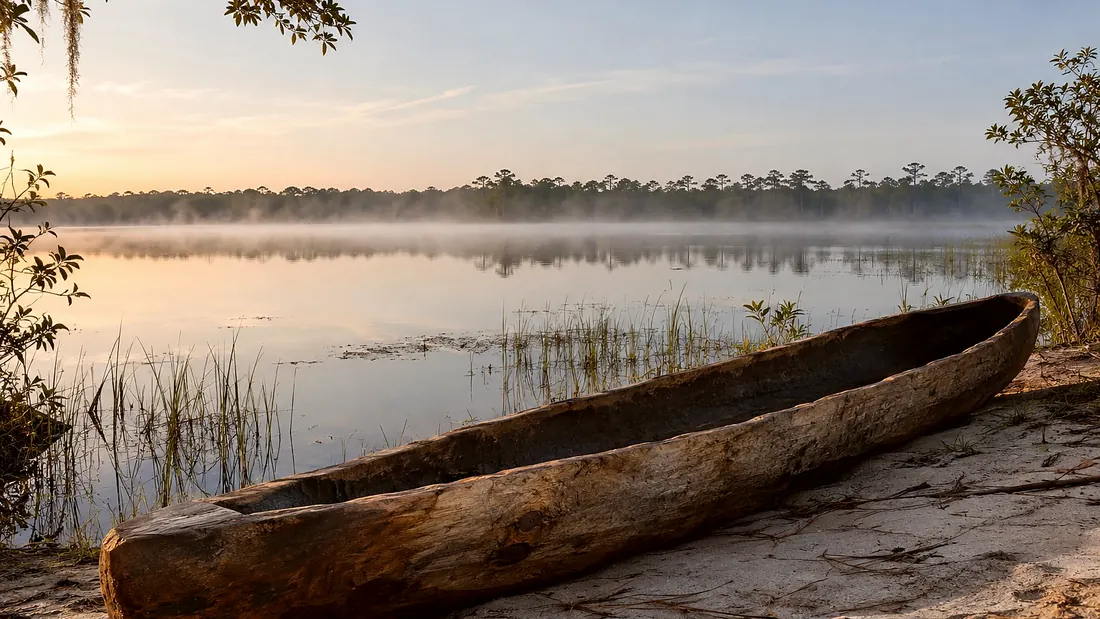
Before anybody called this place the Okefenokee, Spanish records called it the Laguna de Oconi. That means the lake of the Oconi, and it tells you who was living here.
The Oconi were Timucua people, a chiefdom already here when the Europeans arrived. They lived on one island or several islands in the swamp. East of the swamp, on or near Trail Ridge, lived another Timucua people, the Ibihica, with towns of their own.
They were not the first. People have lived in and around this swamp since about twenty-five hundred years before Christ. Archaeologists name those older peoples for their pottery and their sites, the Deptford, the Swift Creek, and the Weeden Island cultures. They changed the land only a little. Mostly they set fires outside the lightning season, to help with hunting, to keep berry fields open, and to clear ground.
Then came the Spanish, with friars and missions. The Ibihica had one called San Lorenzo de Ibihica. The Oconi had one called Santiago de Oconi. In sixteen fifty-five the Spanish tried to move the people of Oconi to another mission, Nombre de Dios. When they would not go, the Spanish burned the Oconi town. Most of the people ran into the woods and never came back to their homes, or to Spanish control. The next year came the Timucua rebellion of sixteen fifty-six, and Ibihica and a nearby Oconi village were apparently destroyed.
That was not the whole of the loss. Within a hundred years of first contact, the Native population of the Southeast had dropped by eighty percent. Disease did much of it, and so did forced labor under the Spanish. Then, between seventeen oh two and seventeen oh four, Colonel James Moore led a horrific slaughter of Timucua and Apalachee people.
The survivors broke apart into smaller bands. Oconi, Creek, Yuchi, Hitchiti, and other peoples moved south into the Okefenokee region during the seventeen hundreds, to hunt and to gather what the swamp gave. Over time the bands grew together and took in people escaping slavery. By the late seventeen hundreds, about two thousand Native people and runaways made up a new and separate people, and others began calling them Seminoles.
They had their own name for the swamp. In the Muskogean languages, Owa-ka-feno-kah, or Akinfinocau, means shaking water in a low place. To the Creek Nation it was a most blissful spot on Earth.
By eighteen twenty-seven, treaty after treaty had pushed the Creeks entirely out of Georgia and cut their physical tie to the swamp. After the Creek War of eighteen thirty-six, the Creeks still in the Southeast were sent to Oklahoma, where they still live today as the Muscogee Nation.
But the tie was never cut in their minds. The Muscogee Nation holds that the swamp is a sacred landscape, and that it holds the remains of their ancestors. In twenty twenty they began a proposal to list the whole refuge as a Traditional Cultural Property. The Fish and Wildlife Service said it strongly agreed, and that process is still going.
So when somebody tells you this was empty wilderness until the loggers came, you can set them straight. The Oconi and the Ibihica were here when the Spanish came. And the name on the sign is not an English name at all.